Topic 2 – Weekly Reflection Blog Post
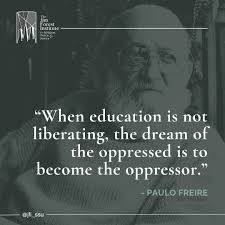
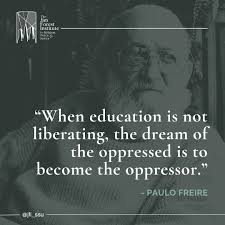
The film Most Likely to Succeed argues that we need to re-imagine education–I think that’s probably true. With that in mind, I can’t help but be reminded of this Paulo Freire quote: “When education is not liberating, the dream of the oppressed is to become the oppressor”. I tend to agree with Althusser’s assessment of schools as Ideological State Apparatus, existing to ensure to reproduction of the conditions for production. The school system is designed to create a new generation of workers who will accept their assigned roles without fundamentally questioning the system’s inequality or the subject’s alienation.
Students learn what Antonio Gramsci referred to as “common sense,” the uncritical, largely unconscious, and fragmented collection of beliefs, prejudices, moral principles, and popular lore that saturates everyday life. It is the “philosophy of the non-philosophers.” By inundating students with an incoherent and contradictory worldview, common sense secures the spontaneous consent of the subordinated. It is the “folklore of philosophy” that must be engaged with and transformed. Gramsci calls the critical, coherent, and reflective kernel within common sense, “good sense.” It represents the practical, empirical understanding and progressive possibilities already present in people’s lived experience. A rational understanding of the world that involves the ability to make logical connections, draw distinctions, and think systematically should be at the heart of any re-imagining of education.
Gramsci’s distinction between good and common sense is at the centre of how I view a lesson vs a learning plan. A lesson plan often embodies Gramsci’s notion of “common sense”: the standardized, uncritical, and often incoherent collection of methods and templates that reinforce the educational status quo. It focuses on what the teacher will deliver, treating knowledge as a fixed commodity to be transferred, which maintains a conservative, teacher-centered classroom dynamic. This approach reflects the hegemonic “way things are done,” prioritizing coverage and control over a truly liberating education.
In contrast, a true learning plan might better align with Gramsci’s “good sense.” It starts from students’ lived experiences and intuitive understandings, designing activities that help them actively construct their knowledge systematically. The learning plan can aim for the intellectual and moral development of critical consciousness in a way the lesson plan can not, empowering students to question and reshape their world.